Solar Battery Cost 2026: Installed Price per kWh From Program Records
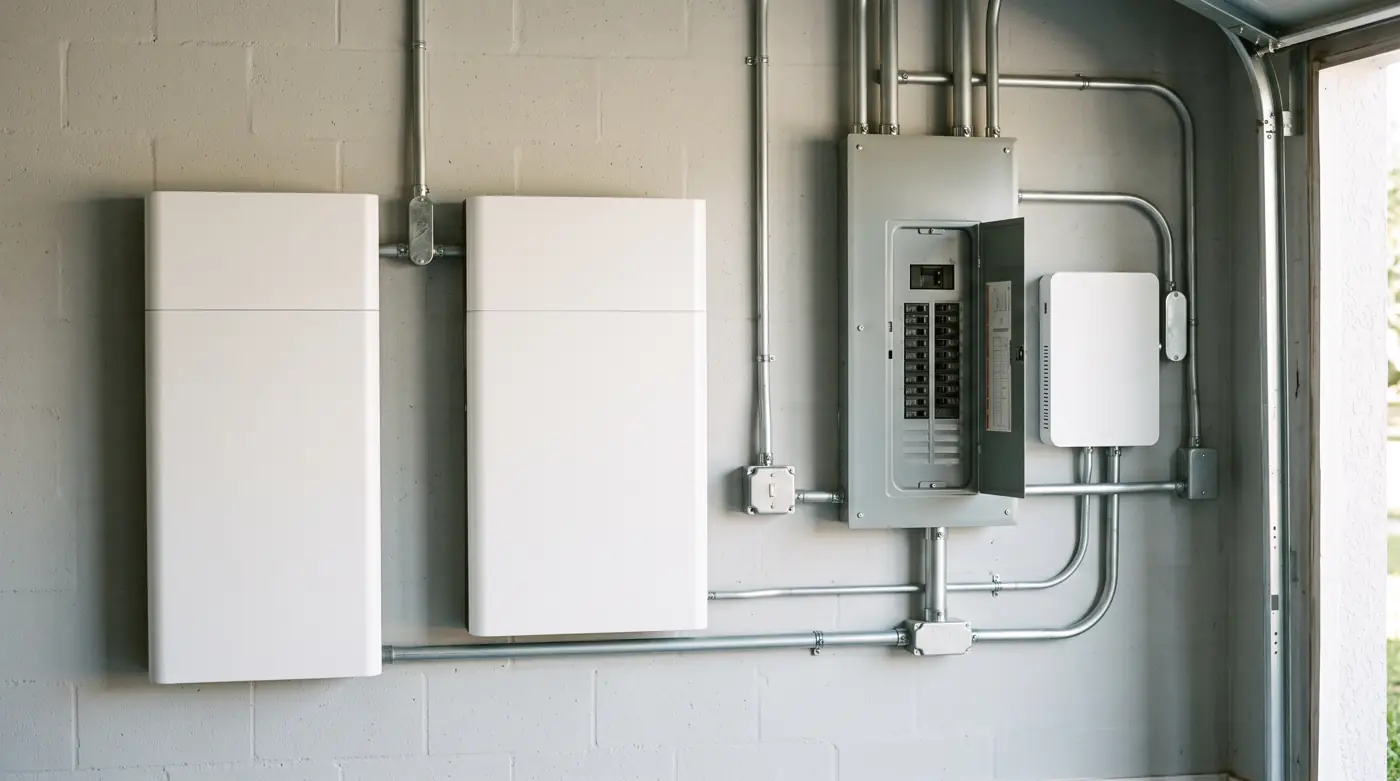
- Data
- California SGIP public project data export (residential battery storage records)
- Period
- SGIP program years 2017 to 2025; Connecticut and New York completions 2024 to 2025; incentives and recalls checked 2026-11-02; state records and code text checked 2026-11-03
- Release used
- 2026-11-02
- Next release
- SGIP export updates weekly; Berkeley Lab data update yearly (next expected 2027)
- Geography
- California (SGIP); state records for CT, NY, OR, HI; incentives for CA, CT, MA, OR, MD; recalls United States
- Sources
- 28 (26 official)
The median solar battery cost in California SGIP records was $1,266 per kWh installed for 2025 program-year home projects (n = 1,541), and the median project cost $20,900; the median battery held 14.3 kWh. The program's $150 per kWh incentive cut the median project to $18,560. Completed 2025 projects ran $1,158 per kWh in Connecticut and $929 in New York.
The median solar battery cost in SGIP records was $1,266 per kWh in 2025
California's Self-Generation Incentive Program publishes the eligible installed cost, capacity and make of every battery it funds. For 2025 program-year home projects with incentives paid, the median was $1,266 per kWh, and the middle half of projects fell between $1,072 and $1,467.
The SGIP public project data export pulled on November 2, 2026 holds 95,499 residential and single-family battery records. Of these, 57,196 have incentives paid, covering 1,104,839 kWh of storage. This report prices the general market budget (Small Residential Storage), where 1,541 paid projects carry a 2025 program year.
Installed cost per kWh: SGIP Total Eligible Project Cost for the storage system divided by its energy capacity in kWh. Under the SGIP Handbook 2026, eligible cost can include equipment, design, permitting, installation, interconnection, sales tax and warranty (warranty capped at 10% of claimed cost). It is the price before any incentive.
The median 2025 project held 14.3 kWh, was rated 11.5 kW and cost $20,900. A quarter of projects cost less than $16,100 and a quarter more than $30,160. 98.1% of these batteries are recorded as paired with solar.
Projects still in Reserved status, whose costs were entered at reservation and are not yet verified, show the same price: a median of $1,267 per kWh across 922 projects.
Battery prices per kWh rose 54.9% from 2017 to 2025 in program records
Unlike panel prices, the installed price of home batteries in SGIP records has not fallen. The median climbed from $817 per kWh in 2017 to a nominal high of $1,298 in 2023 and stood at $1,266 in 2025.
Paid residential projects by program year, with 25th and 75th percentiles
Source: California SGIP public project data (export of 2026-11-02); ECW analysis; BLS CPI-U
| Program year | Paid projects (n) | 25th percentile $/kWh | Median $/kWh | 75th percentile $/kWh | Median size (kWh) | Median project cost ($) | Median $/kWh in 2025 dollars |
|---|---|---|---|---|---|---|---|
| 2017 | 2,373 | $705 | $817 | $915 | 13.2 | $12,008 | $1,073 |
| 2018 | 5,410 | $733 | $834 | $909 | 8.4 | $7,449 | $1,069 |
| 2019 | 4,121 | $852 | $977 | $1,174 | 13.2 | $12,942 | $1,231 |
| 2020 | 7,922 | $856 | $1,000 | $1,098 | 13.2 | $13,900 | $1,244 |
| 2021 | 6,543 | $1,008 | $1,110 | $1,291 | 13.2 | $15,900 | $1,319 |
| 2022 | 4,778 | $1,032 | $1,265 | $1,481 | 13.2 | $16,950 | $1,391 |
| 2023 | 3,661 | $1,061 | $1,298 | $1,521 | 13.2 | $16,995 | $1,371 |
| 2024 | 1,707 | $603 | $1,136 | $1,471 | 13.2 | $15,094 | $1,166 |
| 2025 | 1,541 | $1,072 | $1,266 | $1,467 | 14.3 | $20,900 | $1,266 |
Paid general market (Small Residential Storage) records, $200 to $5,000 per kWh screen. Program year is the year the application was accepted. 2025 dollars use BLS CPI-U annual averages.
Source: [1][8] California Self-Generation Incentive Program Administrators (PG&E, SCE, SoCalGas, CSE, LADWP); U.S. Bureau of Labor Statistics
After inflation the rise is smaller. In 2025 dollars, using BLS CPI-U annual averages, the 2017 median equals $1,073 per kWh, so the real increase to 2025 is 17.9%. The real peak came in 2022 at $1,391; 2025 sits 9.0% below it.
The records do not say why prices rose, and this report does not assign a cause. Over the same years the general market incentive stepped down from $0.50 to $0.15 per Wh, and the 2025 median system was larger (14.3 kWh) than in any earlier year. Program year is the year SGIP accepted the application, not the install date.
The flat $7,000 records described above also sit inside earlier years. In 2018 the developer filed 1,851 of them, 34.2% of the sample, and the 2018 median of $834 per kWh is that flat value itself ($7,000 for an 8.4 kWh unit). Table t8 shows every year with and without them. Removing them does not erase the rise: the 2017 median without them is $769 per kWh, or $1,010 in 2025 dollars, so the real increase to 2025 is 25.3%. The developer has no records in the 2025 price sample.
| Program year | Paid projects in price sample (n) | Flat-cost records (one developer, 7,000 or 14,000 dollars per record) | Flat-cost share (%) | Median $/kWh, all records | Median $/kWh without flat-cost records | Projects without flat-cost records (n) |
|---|---|---|---|---|---|---|
| 2017 | 2,373 | 338 | 14.2 | $817 | $769 | 2,035 |
| 2018 | 5,410 | 1,851 | 34.2 | $834 | $814 | 3,559 |
| 2019 | 4,121 | 397 | 9.6 | $977 | $985 | 3,724 |
| 2020 | 7,922 | 1,066 | 13.5 | $1,000 | $1,023 | 6,856 |
| 2021 | 6,543 | 300 | 4.6 | $1,110 | $1,129 | 6,243 |
| 2022 | 4,778 | 448 | 9.4 | $1,265 | $1,283 | 4,330 |
| 2023 | 3,661 | 369 | 10.1 | $1,298 | $1,375 | 3,292 |
| 2024 | 1,708 | 528 | 30.9 | $1,136 | $1,364 | 1,180 |
From the 2026-11-03 re-pull of the SGIP export (one more 2024 record than the 2026-11-02 pull). Flat-cost records are the named developer's records whose Total Eligible Costs is exactly $7,000 or $14,000. The developer has no records in the 2025 price sample.
Source: [28] California Self-Generation Incentive Program Administrators (PG&E, SCE, SoCalGas, CSE, LADWP)
Records in the price sample after the $200 to $5,000 per kWh screen
Source: California SGIP public project data (export of 2026-11-02); ECW analysis
Volume in the general market sample peaked at 7,922 paid projects in program year 2020 and was 1,541 in 2025. The 2026 handbook allocates 63% of 2020 to 2024 collections to Equity Resiliency and 7% to Small Residential Storage. Berkeley Lab reports the battery attachment rate for new US solar systems; see average cost of solar panels for that series.
Larger batteries cost less per kWh: $1,760 under 12 kWh, $1,025 at 30 kWh and up
Per-kWh cost falls as system size rises, because fixed costs (labor, permitting, gateway and electrical work) are spread over more storage. Differences by make are smaller than differences by size. Minimum group size is 30 paid projects.
SGIP general market, paid projects
Source: California SGIP public project data (export of 2026-11-02); ECW analysis
| Battery size band | Paid projects (n) | 25th percentile $/kWh | Median $/kWh | 75th percentile $/kWh | Median project cost ($) | Median rated kW |
|---|---|---|---|---|---|---|
| Under 12 kWh | 107 | $1,432 | $1,760 | $2,079 | $15,600 | 7.7 |
| 12 to 14.9 kWh | 683 | $1,063 | $1,288 | $1,542 | $17,000 | 11.5 |
| 15 to 19.9 kWh | 229 | $1,178 | $1,333 | $1,534 | $20,980 | 10.0 |
| 20 to 29.9 kWh | 449 | $1,023 | $1,231 | $1,288 | $32,500 | 11.5 |
| 30 kWh and over | 73 | $872 | $1,025 | $1,124 | $32,995 | 20.0 |
Paid general market records. Medians and quartiles are computed within each band.
Source: [1] California Self-Generation Incentive Program Administrators (PG&E, SCE, SoCalGas, CSE, LADWP)
Two sizes dominate 2025 records: 41.1% of projects are 13 to 13.9 kWh and 27.8% are 26 to 27.9 kWh. Tesla-make projects of 13.2 kWh had a median cost of $17,000 (middle half $14,000 to $20,000); 26.4 kWh projects had $32,500.
Makes with 30 or more paid SGIP projects, alphabetical
Source: California SGIP public project data (export of 2026-11-02); ECW analysis
| Battery make (as named in SGIP record) | Paid projects (n) | 25th percentile $/kWh | Median $/kWh | 75th percentile $/kWh | Median size (kWh) | Median project cost ($) |
|---|---|---|---|---|---|---|
| Enphase | 156 | $1,304 | $1,614 | $1,970 | 9.5 | $18,341 |
| FranklinWH | 225 | $1,099 | $1,267 | $1,433 | 15.0 | $20,980 |
| Tesla | 1,082 | $1,053 | $1,231 | $1,423 | 13.2 | $22,000 |
| All other makes (each under 30 projects) | 78 | $993 | $1,240 | $1,567 | 14.4 | $16,500 |
Make as named in the SGIP Equipment Manufacturer field, with spelling variants merged. Battery models are not recorded. No make is ranked or recommended.
Source: [1] California Self-Generation Incentive Program Administrators (PG&E, SCE, SoCalGas, CSE, LADWP)
Makes are listed alphabetically and are not ranked. The SGIP record names the manufacturer but not the model, so make medians mix product generations and sizes. 78 further 2025 projects used makes with fewer than 30 records each; together their median was $1,240 per kWh.
Outside California, home batteries cost $929 to $1,158 per kWh in program records
California is not the only state that publishes per-project battery costs. Connecticut's Energy Storage Solutions and NYSERDA's storage incentive data list cost and capacity for each home project; Oregon and Hawaii publish project costs without kWh. The SGIP median stays the anchor because it is the largest of these records.
California SGIP program year 2025; Connecticut and New York projects completed in 2025
Sources: California SGIP public data; Connecticut Green Bank ESS Enrollment (data.ct.gov); NYSERDA storage incentive data (data.ny.gov); ECW analysis
| State | Record | Year basis | Projects (n) | Median $/kWh | Middle half $/kWh | Median kWh | Median project cost | Measure | Tier |
|---|---|---|---|---|---|---|---|---|---|
| California | SGIP general market, paid (anchor) | Program year 2025 (application year) | 1,541 | $1,266 | $1,072 to $1,467 | 14.3 | $20,900 | Median of per-project records; kWh nameplate | 1 |
| Connecticut | Energy Storage Solutions, completed residential | Completed 2025 | 226 | $1,158 | $1,068 to $1,352 | 30.0 | $32,424 | Median of per-project records; Total Battery Cost / nameplate kWh | 1 |
| Connecticut | Energy Storage Solutions, completed residential | Completed 2024 | 175 | $1,279 | $1,181 to $1,632 | 26.0 | $33,000 | Median of per-project records; Total Battery Cost / nameplate kWh | 1 |
| New York | NYSERDA residential storage, completed | Completed 2025 | 704 | $929 | $762 to $1,269 | 13.0 | $15,000 | Median of per-project records; Total Project Cost / usable kWh (ac) | 1 |
| New York | NYSERDA residential storage, completed | Completed 2024 | 730 | $889 | $762 to $1,111 | 13.0 | $12,489 | Median of per-project records; Total Project Cost / usable kWh (ac) | 1 |
| Oregon | Solar + Storage Rebate, paid residential storage | Funding year 2024 | 422 | Not published (no kWh field) | Not published | Not published | $19,983 | Median per-project storage cost only | 1 |
| Oregon | Solar + Storage Rebate, paid residential storage | Funding year 2023 | 980 | Not published (no kWh field) | Not published | Not published | $22,500 | Median per-project storage cost only | 1 |
| Hawaii (Honolulu County) | Battery-only building permits | Permits issued 2025 | 186 | Not published (no kWh field) | Not published | Not published | $11,500 | Median permit accepted value per project (agency median) | 1 |
| Hawaii (Honolulu County) | Battery-only building permits | Permits issued 2024 | 315 | Not published (no kWh field) | Not published | Not published | $11,500 | Median permit accepted value per project (agency median) | 1 |
Medians of per-project records with the same $200 to $5,000 per kWh screen. Year bases differ: SGIP program year is the application year; Connecticut and New York use completion year. New York divides by usable ac kWh, the others by nameplate kWh. Oregon and Hawaii publish no battery kWh, so only per-project values are shown; Hawaii values are building permit accepted values as tabulated by DBEDT. Massachusetts, Maryland, Illinois and Puerto Rico: no public per-project battery cost record was found.
Source: [1][23][22][24][25] California Self-Generation Incentive Program Administrators (PG&E, SCE, SoCalGas, CSE, LADWP); Connecticut Green Bank (program administered with Eversource and UI, overseen by PURA), via data.ct.gov; New York State Energy Research and Development Authority (NYSERDA), via data.ny.gov; Oregon Department of Energy, via data.oregon.gov; Hawaii Department of Business, Economic Development and Tourism, Research and Economic Analysis Division
Connecticut: the Energy Storage Solutions enrollment data (updated October 1, 2026) list 1,323 completed residential projects; 494 report no battery cost and are left out. The 226 completed in 2025 with cost data had a median of $1,158 per kWh (middle half $1,068 to $1,352), 8.5% below the SGIP 2025 median. Connecticut systems are larger: the median 2025 project held 30.0 kWh and cost $32,424, and larger systems cost less per kWh in SGIP records too. One contractor accounts for 137 of the 226 records, so the 2025 figure leans on its prices. Completed 2024 projects had a median of $1,279 per kWh (n = 175).
New York: NYSERDA's residential storage records (reporting period October 4, 2026) show a 2025 median of $929 per kWh across 704 completed projects (middle half $762 to $1,269), with a median usable capacity of 13.0 kWh and a median cost of $15,000. NYSERDA divides by usable ac kWh, which cannot exceed nameplate, so the kWh basis does not explain the lower figure. 177 of the 2025 records sit at exactly $761.54 per kWh, all from one contractor; without them the median is $1,065. Only 27.4% of 2025 completed records show NYSERDA funding above zero. The 2024 median was $889 (n = 730).
Oregon: the Solar + Storage Rebate data (rebates issued through June 30, 2025) record storage cost per project but no storage kWh, so no per-kWh figure can be computed. The median storage cost was $19,983 for 422 residential projects in funding year 2024 and $22,500 for 980 in 2023; 68.2% of the 2024 projects received the $2,500 storage rebate cap.
Hawaii: DBEDT's April 2026 report on Honolulu County building permits counts 186 battery-only residential permits in 2025, which DBEDT describes as presumably batteries added to existing solar, at a median accepted permit value of $11,500 (average $14,776). Permit values are declared at permitting, are not verified prices and carry no kWh.
A whole home battery backup needs about 2.1 batteries of 13.5 kWh for an average US day
Whether a battery can run a whole house depends on two numbers: stored energy (kWh), which sets how long it lasts, and power (kW), which sets how many loads can run at once. Federal consumption data set the energy side.
EIA-861 final data for 2025, released October 7, 2026, put average residential use at 874.28 kWh a month nationally and 493.53 kWh in California. That is 28.7 kWh and 16.2 kWh a day. A 13.5 kWh battery, Berkeley Lab's 2025 median size, holds 47.0% of an average US day.
- Average US home, one full day: 28.7 kWh, about 2.1 batteries of 13.5 kWh.
- Average California home, one full day: 16.2 kWh, about 1.2 batteries.
- Power: the median 2025 SGIP battery was rated 11.5 kW of continuous output.
- Cost at the 2025 SGIP median: one 13.5 kWh battery about $17,084; a two-unit 26.4 kWh project $32,500 (median of Tesla-make records).
Averages hide the loads that decide backup sizing: electric heat, central air conditioning, well pumps and EV charging. SGIP also requires load justification for single-family batteries above 15 kWh. Panel work that can come with a battery is priced in electrical panel upgrade cost. A licensed electrician should do the load calculation and the work: hire an electrician.
Incentives take $30 to $1,100 per kWh off, depending on state and income
Battery incentives come in two forms: upfront rebates per kWh or per project, and performance payments for letting the utility discharge the battery during peak events. The federal credit no longer applies to new installs.
| Program | State | Published incentive | Value per kWh, 13.5 kWh battery | Status checked 2026-11-02 | Source |
|---|---|---|---|---|---|
| SGIP Small Residential Storage (general market), Step 7 | California | $0.15 per Wh, capped at 30 kWh | $150 upfront | Open; $1,923,197.11 statewide funds available on 2026-11-01 | s3, s4 |
| SGIP Equity Resiliency | California | $1.00 per Wh | $1,000 upfront | Income or resiliency qualified customers | s3 |
| SGIP Residential Solar and Storage Equity | California | $1.10 per Wh storage plus $3.10 per W solar | $1,100 upfront | Low-income customers; $280 million authorized | s3, s5 |
| Energy Storage Solutions (standard customer) | Connecticut | $30 per kWh enrollment plus $300 per kW performance for 10 years | $30 upfront; $630 over 10 years in the program's 30 kWh example | New rates effective 2026-04-01 | s12, s13 |
| Energy Storage Solutions (Grid-Edge customer) | Connecticut | $130 per kWh enrollment | $130 upfront | Effective 2026-04-01 | s12 |
| ConnectedSolutions (Mass Save) | Massachusetts | $275 per kW of average summer event contribution | $101.85 per year at a 5 kW contribution | Rate as captured 2026-06-17 | s14 |
| Oregon Solar + Storage Rebate | Oregon | $300 per kWh, up to 40% of net cost (60% low or moderate income) or $2,500 | $185.19 upfront (cap binds) | Not accepting reservations; $1.1 million fully reserved after the June 15, 2026 reopening | s15, s16 |
| Residential and Commercial Energy Storage Program FY27 | Maryland | 30% of total project cost, up to $5,000 | $350.21 at the SGIP median project | Open; deadline May 31, 2027; budget up to $4,000,000 | s17 |
| Residential Clean Energy Credit (25D) | Federal | 30% of cost for property placed in service 2022 to 2025 | Not available | Ended for property placed in service after December 31, 2025 | s19 |
Per-kWh values for a 13.5 kWh battery are this report's conversions (derived metric d15). Oregon and Maryland conversions apply California SGIP costs for illustration.
Source: [3][4][5][12][13][14][15][16][17][19] California Self-Generation Incentive Program Administrators; California Self-Generation Incentive Program Administrators; California Public Utilities Commission; Connecticut Green Bank, Eversource and UI (overseen by PURA); Connecticut Green Bank, Eversource and UI (overseen by PURA); Sponsors of Mass Save (Massachusetts utilities); Oregon Department of Energy; Oregon Department of Energy; Maryland Energy Administration; Internal Revenue Service
Published program rates converted to dollars per kWh
Sources: SGIP Handbook 2026; Maryland Energy Administration; Oregon Department of Energy; Energy Storage Solutions (CT); ECW conversions
California: the SGIP Handbook 2026 sets the general market Small Residential Storage rate at $0.15 per Wh at Step 7, down from $0.50 at Step 1, with single-family incentives capped at 30 kWh. The statewide budget page showed $1,923,197.11 still available on November 1, 2026. Income-qualified customers get $1.00 per Wh (Equity Resiliency) or $1.10 per Wh plus $3.10 per W of solar (Residential Solar and Storage Equity, for which the CPUC authorized $280 million).
| SGIP budget category | Paid projects (n) | Median $/kWh | 25th percentile $/kWh | 75th percentile $/kWh | Median incentive $/kWh | Median project cost ($) |
|---|---|---|---|---|---|---|
| Small Residential Storage | 1,541 | $1,266 | $1,072 | $1,467 | $150 | $20,900 |
| Equity Resiliency | 939 | $1,427 | $1,113 | $1,555 | $1,000 | $25,000 |
| Residential Solar and Storage Equity – AB 209 Non-POU | 782 | $1,571 | $1,571 | $1,837 | $1,100 | $21,957 |
| Residential Solar and Storage Equity – Ratepayer | 615 | $1,871 | $1,597 | $1,940 | $1,100 | $27,164 |
| Residential Storage Equity | 341 | $1,930 | $1,768 | $2,310 | $850 | $28,950 |
| Residential Solar and Storage Equity – AB 209 | 210 | $1,748 | $1,359 | $1,930 | $1,100 | $26,095 |
| Residential Solar and Storage Equity – AB 209 POU | 54 | $1,288 | $1,257 | $1,434 | $625 | $33,097 |
Paid residential records with 30 or more projects per category, same screen. Equity budgets allow panel and wiring upgrades up to $3,500 per project.
Source: [1][3] California Self-Generation Incentive Program Administrators (PG&E, SCE, SoCalGas, CSE, LADWP); California Self-Generation Incentive Program Administrators
In the equity budgets the incentive covers most of the cost: the Equity Resiliency rate equals 70.1% of that budget's 2025 median of $1,427 per kWh. Equity projects also cost more per kWh than general market projects; panel and wiring upgrades up to $3,500 are allowable costs only in the equity budgets.
Connecticut: Energy Storage Solutions pays $30 per kWh upfront ($130 for Grid-Edge customers) from April 1, 2026, plus a performance incentive of $300, $450 or $550 per kW for standard, Underserved and Low Income customers, paid each season for 10 years. In the program's own example, a 30 kWh, 20 kW battery earns $900 upfront and an estimated $18,000 in performance payments, about $630 per kWh over 10 years.
Massachusetts: ConnectedSolutions paid $275 per kW of average battery contribution during summer events (up to 60 events a summer, each up to three hours) as captured June 17, 2026: $1,375 a year for a 5 kW contribution, or $102 per kWh of a 13.5 kWh battery per year.
Oregon and Maryland: Oregon offers $300 per kWh up to $2,500, but reservations are closed after the June 2026 round filled. Maryland pays 30% of project cost up to $5,000 through May 31, 2027; the cap binds on any project above $16,667.
Federal: the Residential Clean Energy Credit covered 30% of battery cost (3 kWh minimum) for property placed in service from 2023 through 2025 and is not available after December 31, 2025. Details: solar tax credit. Export credit rules are in net metering by state. Nothing here is tax or financial advice.
CPSC lists 5 home battery recalls since 2020, covering 34,060 units
Home batteries are listed to UL 9540 and installed under the residential code, which caps unit size and total storage by location. Recalls since 2020 involve lithium-ion cells that can overheat.
| Recall date | Recalling firm | Product (as named by CPSC) | Units recalled (US) | CPSC recall number | Source URL |
|---|---|---|---|---|---|
| 2020-12-16 | LG Energy Solution Michigan | LG Chem "RESU 10H" Lithium-Ion Residential Energy Storage System | 1,815 | 21055 | https://www.cpsc.gov/Recalls/2021/LG-Energy-Solution-Michigan-Recalls-Home-Energy-Storage-Batteries-Due-to-Fire-Hazard |
| 2021-08-04 | LG Energy Solution Michigan | LG Chem "RESU10H" Lithium-Ion Residential Energy Storage System Batteries | 10,000 | 21175 | https://www.cpsc.gov/Recalls/2021/LG-Energy-Solution-Michigan-Recalls-Home-Energy-Storage-Batteries-Due-to-Fire-Hazard-0 |
| 2022-01-26 | Eguana Technologies | Evolve Home Energy Storage Systems | 245 | 22058 | https://www.cpsc.gov/Recalls/2022/Eguana-Technologies-Recalls-Evolve-Home-Energy-Storage-Systems-with-LG-Battery-Due-to-Fire-Hazard |
| 2022-10-27 | LG Energy Solution Michigan | LG Energy Solution "RESU 10H" Lithium-Ion Residential Energy Storage System Batteries | 11,500 | 23705 | https://www.cpsc.gov/Recalls/2023/LG-Energy-Solution-Michigan-Recalls-Home-Energy-Storage-Batteries-Due-to-Fire-Hazard-Recall-Alert |
| 2025-11-13 | Tesla | Certain Tesla Powerwall 2 AC Battery Power System | 10,500 | 26092 | https://www.cpsc.gov/Recalls/2026/Tesla-Recalls-Powerwall-2-AC-Battery-Power-Systems-Due-to-Fire-and-Burn-Hazards-Risk-of-Serious-Injury-or-Death |
Portable power stations are excluded. Units are US units as stated by CPSC.
Source: [11] U.S. Consumer Product Safety Commission
The CPSC recalls database, searched for all recalls dated January 1, 2020 to November 2, 2026, shows 5 recalls of installed home energy storage batteries. The most recent, on November 13, 2025, covers about 10,500 Tesla Powerwall 2 units after 22 reports of overheating, including six of smoking and five of fire, with no injuries reported. Three recalls cover LG RESU 10H batteries and one an Eguana system using LG battery modules. 5 recalls of portable power stations in the same pull are not counted.
- Listing: 2021 IRC Section R328.2 says energy storage systems "shall be listed and labeled in accordance with UL 9540," the safety standard for energy storage systems and equipment.
- Unit size: R328.5 says "Individual ESS units shall have a maximum rating of 20 kWh."
- Total size: R328.5 caps the aggregate rating at 40 kWh within utility closets, basements and storage or utility spaces, and at 80 kWh in attached or detached garages and detached accessory structures, on exterior walls, or outdoors on the ground. Larger installations fall under International Fire Code Section 1207.
- Locations: R328.4 allows detached garages and accessory structures, attached garages separated from living space, outdoors or on exterior walls at least 3 feet from doors and windows into the home, and enclosed utility spaces with finished or noncombustible walls (5/8-inch Type X gypsum board over unfinished wood framing). It bars sleeping rooms and closets or spaces opening into them.
- Spacing: R328.3.1 requires 3 feet between units unless large-scale fire testing documents a smaller distance. UL 9540A is the fire propagation test method used for that testing.
Edition and source: the wording above is 2021 IRC Section R328 as reproduced by the Washington State Building Code Council in January 2023; Washington's own edits are marked in that document and none appears in R328.4 or R328.5. UL's 2021 code-authorities summary gives the same limits. In the 2024 IRC these provisions are numbered Section R330, according to the council's April 2026 analysis. The 2024 IRC text and NFPA 855 (2023 edition) Chapter 15 could not be opened for this report, because the ICC and NFPA free-access pages load only through a browser script, so their wording is not quoted here.
Local adoption of code editions varies, and later editions may change these limits. Battery installs involve service equipment and stored energy; the work belongs with a licensed electrician (EV, solar and low-voltage work). Recall history for panels is in electrical panel recalls.
A battery stores less than one average day; a standby generator runs on fuel
Batteries and standby generators solve outages differently, and their prices are tracked separately.
One 13.5 kWh battery holds 47.0% of an average US home's daily use (EIA-861, 2025), so long outages depend on solar recharging, while a standby generator runs as long as its fuel supply lasts. Generator prices are in whole house generator cost; outage frequency by state is in power outages by state.
The math behind the moves
Median installed $/kWh, latest program year
Formulamedian(Total Eligible Project Cost / kWh), paid general market records, program year 2025
Inputs: fact sheet rows 6 to 9 (fact sheet rows)
Result: $1,266 per kWh (IQR $1,072 to $1,467; n = 1,541)
The typical installed price of a home battery in California's largest public battery record, before incentives.
Limitations: California only; applicant-reported eligible cost; program year is the application year.
Trend, 2017 to 2025, nominal and real
Formulamedian2025 / median2017 - 1; real uses CPI-U 2025 / CPI-U year
Inputs: table t1; CPI-U rows (fact sheet rows)
Result: +54.9% nominal; +17.9% real; real peak 2022 at $1,391
Battery prices per kWh have not followed the long decline in solar panel prices in these records.
Limitations: Mix of system sizes and incentive steps changed over time; 2024 is affected by a repeated value (median $1,289 without it).
Medians by size band and by make (minimum n = 30)
Formulamedian(cost / kWh) within each kWh band and each normalized make, 2025
Inputs: tables t2 and t3 (fact sheet rows)
Result: $1,760 under 12 kWh to $1,025 at 30 kWh and over; makes Enphase $1,614, FranklinWH $1,267, Tesla $1,231
Fixed installation costs make small batteries expensive per kWh; make differences are smaller than size differences.
Limitations: Models are not recorded; bands mix makes.
Incentive value per kWh, dated
Formulapublished rate converted for a 13.5 kWh battery (see derived metric d15)
Inputs: table t4 (fact sheet rows)
Result: $30 (CT standard upfront) to $1,100 (CA equity) per kWh; MD $350; OR $185; MA $102 per year
In these figures the spread in incentive value per kWh is wider than the spread in price between makes.
Limitations: Performance payments depend on dispatch; Oregon is closed to new reservations; Mass Save rate as captured June 17, 2026.
CPSC home energy storage recalls since 2020
Formulacount of CPSC recalls of installed home ESS, January 1, 2020 to November 2, 2026; sum of units
Inputs: table t6 (fact sheet rows)
Result: 5 recalls; 34,060 units
Every recall in the period cited overheating or fire, and four of the five covered more than 1,000 units.
Limitations: Keyword screen plus manual review; portable power stations excluded.
State comparison of median installed $/kWh, 2025
Formulamedian(cost / kWh) of completed residential records per state; state / SGIP2025 - 1 (derived metric d17)
Inputs: table t7 (fact sheet rows)
Result: CA $1,266; CT $1,158 (-8.5%); NY $929 (-26.6%)
Program records in Connecticut and New York put the 2025 median below California's; Connecticut systems are about twice the California median size.
Limitations: Completion year vs application year; New York uses usable ac kWh; one contractor dominates Connecticut 2025; Oregon and Hawaii publish no kWh.
What the 413 identical 2024 records are
Formulagroup 2024 records at $530.30 by developer, installer, make, step, status, kWh and cost; flat-cost share of that developer's records (derived metric d18)
Inputs: table t8; fact sheet re-pull rows (fact sheet rows)
Result: one developer; $7,000 per 13.2 kWh and $14,000 per 26.4 kWh; 99.8% of its records flat; 2024 median $1,289 without the 413
The repeated value is a fixed per-unit cost entry from one developer, not a program default or a performance-based record.
Limitations: The SGIP record does not explain how the developer set the amount; re-pull of 2026-11-03.
Numbers to watch
- Median installed solar battery cost was $1,266 per kWh for 2025 SGIP general market projects in California (n = 1,541; IQR $1,072 to $1,467).[1]
- The median 2025 project cost $20,900 before incentives; the median battery held 14.3 kWh of storage and 11.5 kW of rated power (California, SGIP).[1]
- From 2017 to 2025 the SGIP median rose from $817 to $1,266 per kWh, up 54.9% nominal and 17.9% in 2025 dollars (California).[1][8]
- The 2025 median was 2.5% below the 2023 median of $1,298 per kWh, and 9.0% below the inflation-adjusted 2022 peak of $1,391 (California, 2025 dollars).[1][8]
- In 2025, Tesla-make records sized 13.2 kWh had a median project cost of $17,000 (n = 596); 26.4 kWh records had $32,500 (n = 409) (California, SGIP).[1]
- By size, 2025 medians ran from $1,760 per kWh under 12 kWh to $1,025 per kWh at 30 kWh and over, a 41.8% gap (California, SGIP).[1]
- By make (30+ projects, alphabetical), 2025 medians were Enphase $1,614 per kWh (n = 156); FranklinWH $1,267 per kWh (n = 225); Tesla $1,231 per kWh (n = 1,082) (California, SGIP).[1]
- The SGIP general market pays $0.15 per Wh at Step 7, or $150 per kWh, 11.9% of the 2025 median price; the median project net of it was $18,560 (California, 2026 handbook).[1][3]
- California's equity budgets pay $1.00 to $1.10 per Wh; the Equity Resiliency incentive equals 70.1% of that budget's 2025 median of $1,427 per kWh.[1][3]
- Connecticut home batteries completed in 2025 had a median installed cost of $1,158 per kWh (n = 226; median 30.0 kWh), and New York's $929 per kWh (n = 704; usable kWh), per Connecticut Green Bank and NYSERDA records.[23][22]
- All 413 SGIP 2024 records at an identical $530.30 per kWh come from one developer that recorded $7,000 per 13.2 kWh unit and $14,000 per 26.4 kWh pair; without them the 2024 median is $1,289 per kWh (California).[1][28]
- NLR's Q1 2025 residential benchmark implies $997 per kWh for a 13.5 kWh battery in 2025 dollars; the SGIP 2025 median is 26.9% higher (United States model vs California records).[7][8][1]
- CPSC recorded 5 recalls of installed home energy storage batteries from 2020 to November 2, 2026, covering 34,060 US units, all for fire or overheating hazards.[11]
In short
- Paid home battery projects in California's SGIP general market had a median installed cost of $1,266 per kWh in program year 2025, with half between $1,072 and $1,467 (n = 1,541).
- The median 2025 project cost $20,900 before incentives and the median battery stored 14.3 kWh; the middle half of projects cost $16,100 to $30,160.
- Battery prices per kWh in these records did not fall: the median rose 54.9% from 2017 to 2025 before inflation and 17.9% after inflation, peaking in real terms in 2022.
- Size matters more than make: batteries under 12 kWh had a median of $1,760 per kWh, systems of 30 kWh and over $1,025.
- Outside California, projects completed in 2025 had medians of $1,158 per kWh in Connecticut (n = 226) and $929 in New York (n = 704); Oregon and Hawaii publish project costs but no battery kWh.
- Covering an average US home's 28.7 kWh daily use takes about 2.1 batteries of 13.5 kWh; an average California home needs about 1.2.
- Incentives range from $30 per kWh upfront in Connecticut to $1,100 per kWh in California's low-income budget; the federal 30% credit ended for systems placed in service after December 31, 2025.
What people search for
How much does a Tesla Powerwall cost?
SGIP does not record battery models, but in 2025 program-year records Tesla-make projects sized 13.2 kWh had a median installed cost of $17,000 (middle half $14,000 to $20,000, n = 596), before incentives, in California. Two-unit 26.4 kWh projects had a median of $32,500. Tesla's own list price was not verified for this report.
How much is a whole home battery backup?
Covering one average US day (28.7 kWh in 2025, EIA-861) takes about 2.1 batteries of 13.5 kWh. In 2025 SGIP records, two-unit 26.4 kWh Tesla-make projects had a median cost of $32,500, and systems of 30 kWh and over had a median of $32,995, before incentives and any panel upgrade. In Connecticut, where the median project completed in 2025 held 30.0 kWh, the median battery cost was $32,424.
Is a solar battery worth it?
It depends on outage risk, export credit rules and local incentives, so this report does not give a yes or no. The price side: $1,266 per kWh installed at the 2025 SGIP median, $150 per kWh off in the SGIP general market, up to $1,100 per kWh in California equity budgets, and no federal credit for systems placed in service after 2025. See net metering by state for export credits.
How many batteries do I need to power my house?
For a full average day, about 2.1 batteries of 13.5 kWh nationally and 1.2 in California, based on 2025 EIA-861 average use. In 2025 SGIP records, 41.1% of projects were 13 to 13.9 kWh. The battery's kW rating (median 11.5 kW in 2025 SGIP records) limits how many appliances run at once.
Can you add a battery to existing solar?
Yes. The 2026 SGIP Handbook allows storage paired with an existing solar system, with an engineering estimate of the home's consumption, and Oregon's rebate covers storage paired with previously installed solar. Berkeley Lab notes its attachment rates miss these retrofits. The NLR residential benchmark models an ac-coupled battery with its own 5 kW inverter. In Honolulu County, 186 battery-only permits in 2025, which Hawaii DBEDT describes as presumably additions to existing solar, had a median permit value of $11,500.
Common questions
What is the average solar battery cost per kWh?
The median was $1,266 per kWh installed for 2025 program-year California SGIP projects (n = 1,541), with the middle half between $1,072 and $1,467.
How much does a home battery backup system cost installed?
The median 2025 SGIP general market project cost $20,900 before incentives (median battery size 14.3 kWh); a quarter cost under $16,100 and a quarter over $30,160.
Are bigger batteries cheaper per kWh?
Yes in the 2025 records: batteries under 12 kWh had a median of $1,760 per kWh and systems of 30 kWh and over $1,025, 41.8% less.
How much does an Enphase battery cost?
Enphase-make projects in 2025 SGIP records had a median of $1,614 per kWh and a median project cost of $18,341 at a median 9.5 kWh (n = 156), before incentives, in California.
Have home battery prices gone down?
Not in SGIP records. The median rose from $817 per kWh in 2017 to $1,266 in 2025, up 17.9% after inflation, though it is 9.0% below the 2022 real peak.
Does the federal tax credit still cover solar batteries?
No. The IRS says the 30% Residential Clean Energy Credit is not available for property placed in service after December 31, 2025. Batteries of 3 kWh or more qualified from 2023 through 2025.
How much does SGIP pay for a home battery in 2026?
The general market pays $0.15 per Wh ($150 per kWh) at Step 7, capped at 30 kWh for single-family homes; income-qualified budgets pay $1.00 or $1.10 per Wh, per the 2026 SGIP Handbook.
What safety standards apply to a home battery?
Units are listed to UL 9540, and 2021 IRC Section R328.5 limits each unit to 20 kWh and the total to 40 kWh in utility spaces and basements or 80 kWh in garages, on exterior walls or outdoors. The 2024 IRC moves these rules to Section R330.
How many home batteries have been recalled?
CPSC announced 5 recalls of installed home energy storage batteries from 2020 to November 2, 2026, covering 34,060 US units.
How much does a home battery cost outside California?
For projects completed in 2025, the median was $1,158 per kWh in Connecticut (n = 226) and $929 per kWh in New York (n = 704), against $1,266 in California SGIP records. Oregon's median storage cost was $19,983 per project in funding year 2024.
Get the data
Every table in this report is available as a CSV under CC BY 4.0. The fact sheet lists each value with its source URL and access date.
- derived_metrics.csv (CSV)
- fact_sheet.csv (CSV)
- Installed cost per kWh of residential battery storage by SGIP program year, 2017 to 2025 (CSV)
- Installed cost per kWh by battery size band, program year 2025 (CSV)
- Installed cost per kWh by battery make, program year 2025 (makes with 30 or more paid records, alphabetical) (CSV)
- Battery storage incentives that change the price, checked 2026-11-02 (CSV)
- Installed cost and incentive per kWh by SGIP budget category, program year 2025 (CSV)
- CPSC recalls of installed home energy storage batteries, 2020 to 2026-11-02 (CSV)
- Installed home battery cost in public records by state, latest years (CSV)
- SGIP general market records with a flat $7,000 or $14,000 eligible cost from one developer, 2017 to 2024 (CSV)
Cite this report
The figures to cite first
- Median installed solar battery cost: $1,266 per kWh, 2025 SGIP program year, California (n = 1,541).[1]
- SGIP general market incentive: $150 per kWh, 11.9% of the median price.[3][1]
- Whole-day backup for an average US home: about 2.1 batteries of 13.5 kWh.[9]
- Outside California: $1,158 per kWh in Connecticut and $929 per kWh in New York, projects completed in 2025.[23][22]
Quotable figures
- Home batteries cost a median $1,266 per kWh installed in California's 2025 SGIP program year (n = 1,541).[1]
- The median 2025 SGIP home battery project cost $20,900 before incentives; the median battery held 14.3 kWh.[1]
- Installed battery prices per kWh in SGIP records rose 17.9% from 2017 to 2025 after inflation.[1][8]
- Batteries under 12 kWh cost $1,760 per kWh at the 2025 median; systems of 30 kWh and over cost $1,025.[1]
- One 13.5 kWh battery holds 47.0% of an average US home's daily electricity use in 2025.[9][6]
- CPSC has announced 5 recalls of installed home batteries since 2020, covering 34,060 units.[11]
- Home batteries completed in 2025 had a median installed cost of $1,158 per kWh in Connecticut and $929 per kWh in New York program records.[23][22]
- All 413 SGIP records at an identical $530.30 per kWh in 2024 come from one developer that recorded $7,000 per battery unit.[28]
Summary for editors
Home solar batteries cost a median $1,266 per kWh installed in 2025, according to an Electrical Contractors and Wiring analysis of 1,541 paid projects in California's Self-Generation Incentive Program. The median project cost $20,900 before incentives, and the median battery stored 14.3 kWh. Unlike solar panels, batteries have not become cheaper per kWh in these records: the median rose 17.9% from 2017 after inflation, though it sits 9.0% below its 2022 peak. Size drives price more than make, with small batteries at $1,760 per kWh and systems of 30 kWh and over at $1,025. Program records from other states run lower: $1,158 per kWh in Connecticut and $929 in New York for projects completed in 2025. Incentives now range from $30 per kWh upfront in Connecticut to $1,100 per kWh for low-income California households, while the 30% federal credit ended for systems placed in service after 2025. CPSC has announced 5 home battery recalls since 2020.
Headlines the data supports
- Home batteries cost $1,266 per kWh installed, California program records show
- Solar battery prices per kWh rose 17.9% since 2017 after inflation
- A typical home battery project cost $20,900 in 2025 before incentives
- Home batteries cost $929 to $1,158 per kWh in New York and Connecticut records
- 5 home battery recalls since 2020 covered 34,060 units
Citation
Electrical Contractors and Wiring. (2026). Solar Battery Cost 2026: Installed Price per kWh From Program Records. Retrieved from https://electricalcontractorsandwiring.com/data/solar-battery-cost/
Reuse
Data and tables are licensed CC BY 4.0. Attribution: “Source: Electrical Contractors and Wiring, Solar Battery Cost 2026: Installed Price per kWh From Program Records” with a link to this page.
How we built this report
Source selection: installed prices come from the California Self-Generation Incentive Program public project export (selfgenca.com, pulled November 2, 2026), the only free public record found that lists eligible installed cost, kWh, kW and manufacturer for each funded home battery in a recent full year. Connecticut Green Bank (Energy Storage Solutions enrollment, data.ct.gov) and NYSERDA (storage incentive data, data.ny.gov) records give a state comparison; Oregon Department of Energy rebate data and Hawaii DBEDT permit tabulations give per-project values without kWh. Berkeley Lab, NLR, EIA, BLS, CPSC, IRS and state program pages supply context. Vendor and marketplace prices were reviewed only as pages to beat and are not used as figures.
Inclusion: Equipment Type Electrochemical Storage; Host Customer Sector Residential or Single Family; Budget Classification Paid or PBI in Process (incentive paid after cost documents were checked at claim). The price series uses the general market budget (Small Residential Storage), 38,170 paid records. Cost is Total Eligible Project Cost for storage where reported separately, otherwise Total Eligible Costs. Records below $200 or above $5,000 per kWh were dropped as entry errors (114 records). Size bands and makes require at least 30 paid records. State records: residential, completed, cost and kWh above zero, same $200 to $5,000 per kWh screen, grouped by completion year (Connecticut Total Battery Cost over nameplate kWh; New York Total Project Cost over usable ac kWh); Oregon residential records with a storage cost, by funding year.
Conflicts and sensitivities: equity budgets are shown separately because their incentive rates and allowable costs (including panel upgrades) differ. The 2024 median is shown with and without the 413 records at $530.30 per kWh, which a November 3, 2026 re-pull traced to one developer's flat $7,000 per battery unit entries; table t8 shows every year with and without that developer's flat-cost records. The re-pull added records to program year 2025 (1,550 records, median $1,267 per kWh); the November 2 pull stays the anchor. New York's most repeated value is shown the same way. Reserved 2025 projects were checked against paid ones. Make names were merged across spelling variants (for example Tesla, Tesla Inc. and Tesla Energy).
Derived metrics: inflation adjustment uses BLS CPI-U annual averages (2025 = 321.943). Daily use is EIA-861 2025 monthly consumption x 12 / 365. Incentive per kWh conversions use a 13.5 kWh battery, Berkeley Lab's 2025 median. Formulas and inputs are in derived_metrics.csv; the scripts in scripts/ reproduce every table.
Limitations: SGIP covers California participants only, and California costs differ from other states. Program year is the application year, not the install year. Eligible cost is applicant-reported. State records differ in year basis, kWh basis and system size, so they are compared, not pooled. Recalls cover CPSC actions only. Code limits quote 2021 IRC Section R328 as reproduced by the Washington State Building Code Council; the 2024 IRC (Section R330) and NFPA 855 (2023 edition) text could not be opened, and local adoption varies. Not tax, legal or financial advice.
Last updated November 5, 2026 (state comparison, repeated-value check and code citations added; SGIP figures from the November 2, 2026 export). Data, tables and charts are licensed CC BY 4.0 with attribution to Electrical Contractors and Wiring Data Desk.
This report presents published data with its limitations. It is not legal, financial or investment advice.
Sources by tier
Tier 1: primary and official sources (26)
- [1] California Self-Generation Incentive Program Administrators (PG&E, SCE, SoCalGas, CSE, LADWP). SGIP public project data export (sgip_public_export_2026-11-02.csv). Program years 2001 to 2026, pulled 2026-11-02. Accessed 2026-11-02.
- [2] California Self-Generation Incentive Program Administrators. SGIP Weekly Statewide Report, 11/01/2026, with Report Field Tooltips sheet. As of 2026-11-01. Accessed 2026-11-02.
- [3] California Self-Generation Incentive Program Administrators. Self-Generation Incentive Program Handbook 2026 (V3). 2026. Accessed 2026-11-02.
- [4] California Self-Generation Incentive Program Administrators. SGIP Program Level Budget Summary, Statewide. As of 2026-11-01. Accessed 2026-11-02.
- [5] California Public Utilities Commission. Self-Generation Incentive Program (program page and decision history). 2019 to 2025 decisions. Accessed 2026-11-02.
- [6] Lawrence Berkeley National Laboratory. U.S. Distributed Solar and Storage: 2026 Data Update (summary slide deck, August 2026). 2025 installations. Accessed 2026-11-02.
- [7] National Laboratory of the Rockies (formerly NREL) for the U.S. Department of Energy. Q1-2025 Solar Photovoltaic System Cost Benchmarks (dataset page and 2025 Benchmarks Description, released 2026-01-06). Q1 2025, 2024 dollars. Accessed 2026-11-02.
- [8] U.S. Bureau of Labor Statistics. CPI-U, U.S. city average, all items (CUUR0000SA0), annual averages. 2017 to 2025. Accessed 2026-11-02.
- [9] U.S. Energy Information Administration. Annual Electric Power Industry Report (EIA-861), 2025 final data: Average Monthly Bill, Residential. 2025. Accessed 2026-11-02.
- [10] U.S. Energy Information Administration. Form EIA-861 detailed data files (release dates). Released 2026-10-07. Accessed 2026-11-02.
- [11] U.S. Consumer Product Safety Commission. Recalls API (SaferProducts.gov REST web services), recalls dated 2020-01-01 to 2026-11-02. 2020-01-09 to 2026-10-29 (latest recall in the pull). Accessed 2026-11-02.
- [12] Connecticut Green Bank, Eversource and UI (overseen by PURA). Energy Storage Solutions: energy storage for your home (incentive rates effective 4/1/26). Rates effective 2026-04-01. Accessed 2026-11-02.
- [13] Connecticut Green Bank, Eversource and UI (overseen by PURA). Program Changes for April 1, 2026 (incentive comparison for homes). 2026-04-01. Accessed 2026-11-02.
- [14] Sponsors of Mass Save (Massachusetts utilities). Mass Save: Batteries (ConnectedSolutions), Internet Archive copy of 2026-06-17; live page returned HTTP 403. As captured 2026-06-17. Accessed 2026-11-02.
- [15] Oregon Department of Energy. Oregon Solar + Storage Rebate Program: Homeowners. 2026. Accessed 2026-11-02.
- [16] Oregon Department of Energy. Oregon Solar + Storage Rebate Program (program status, June 2026 update). June 2026. Accessed 2026-11-02.
- [17] Maryland Energy Administration. FY27 Residential and Commercial Energy Storage (RCES) Program Funding Opportunity Announcement, issued 09/24/2026. FY27 (application deadline 2027-05-31). Accessed 2026-11-02.
- [18] Maryland Energy Administration. Maryland Energy Storage Income Tax Credit (inactive program notice). Tax year 2024. Accessed 2026-11-02.
- [19] Internal Revenue Service. Residential Clean Energy Credit. Page reviewed 2026-07-04. Accessed 2026-11-02.
- [22] New York State Energy Research and Development Authority (NYSERDA), via data.ny.gov. Residential, Retail and Bulk Energy Storage Incentive Programs Reported by NYSERDA: Beginning 2019 (dataset ugya-enpy, reporting period 10/04/2026). Projects approved since April 2019; reporting period 2026-10-04. Accessed 2026-11-03.
- [23] Connecticut Green Bank (program administered with Eversource and UI, overseen by PURA), via data.ct.gov. Energy Storage Solutions (ESS) Enrollment (dataset uy2c-bbdw, last updated 2026-10-01). Projects approved 2022 to 2026; data updated 2026-10-01. Accessed 2026-11-03.
- [24] Oregon Department of Energy, via data.oregon.gov. Solar Plus Storage Rebate: Multi-Year Report (dataset fbqx-su36, rebates issued as of June 30, 2025). Funding years 2023 to 2025; rebates issued through 2025-06-30. Accessed 2026-11-03.
- [25] Hawaii Department of Business, Economic Development and Tourism, Research and Economic Analysis Division. Solar PV Battery Installations in Honolulu, 2025 Update (April 2026), Table 1. Building permits issued 2017 to 2025, Honolulu County. Accessed 2026-11-03.
- [26] Washington State Building Code Council. IRC Proposed Correlation Changes (January 2023): reproduces 2021 IRC Section R328 Energy Storage Systems with Washington edits marked. 2021 IRC Section R328 (model code text as reproduced 2023-01). Accessed 2026-11-03.
- [27] Washington State Building Code Council. Economic Impact Analysis, 2024 IRC proposals (April 2026): proposal 24-GP2-023, IRC R330.1 Energy Storage Systems. 2024 IRC adoption cycle, April 2026. Accessed 2026-11-03.
- [28] California Self-Generation Incentive Program Administrators (PG&E, SCE, SoCalGas, CSE, LADWP). SGIP public project data export, re-pulled 2026-11-03 (sgip_public_export_2026-11-03.csv) for the repeated-value check. Program years 2001 to 2026, pulled 2026-11-03. Accessed 2026-11-03.
Tier 2: trade bodies, market research, company data (2)
- [20] UL LLC. 2021 Residential ESS Requirements: IRC Section R328 and NFPA 855 Chapter 15 (code authorities summary, 08/2021; used as a secondary cross-check). 2021 IRC and NFPA 855 requirements. Accessed 2026-11-02.
- [21] UL Solutions. Energy storage system testing and certification (UL 9540, UL 9540A, UL 9540B). Accessed 2026-11-02. Accessed 2026-11-02.